
H100 GPU Server
The proven data-center standard for large-scale AI training and inference.
We help you choose, configure, and deliver the right system. No obligation.
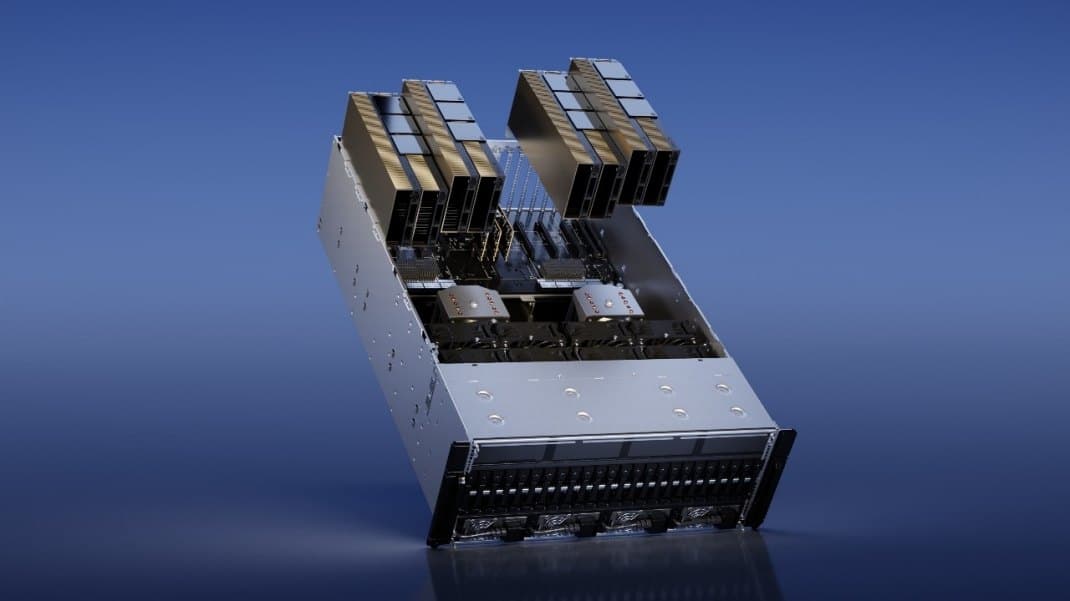

Configuration at a Glance
Tailored per engagement. Full technical overview below.
Configuration Options
Core specifications for this system. Every component is configurable to your workload, so request a quote for a tailored build.
NVIDIA H100 (80GB HBM), PCIe or SXM5
Dual AMD EPYC or Intel Xeon
Up to 2TB ECC
Overview
The H100 GPU Server is built around NVIDIA's H100, the established workhorse of enterprise AI. Its high-bandwidth memory and Transformer Engine make it the reference choice for serious training and high-throughput inference. Nexus Compute sources H100 systems and advises on the configuration that fits your workload and facility. Sizing starts with memory. An H100 carries 80GB, and as a rough guide half-precision inference needs about 2GB per billion parameters for weights before any KV cache, while training with a standard optimizer needs closer to 16GB per billion once gradients and optimizer state are counted. That arithmetic decides whether you need four GPUs or eight, whether the model runs within one node or has to be split with tensor and pipeline parallelism, and whether quantization or CPU offload is a sensible answer or a performance trap. The second question is the building: an eight-way air-cooled H100 node is typically a 10kW-and-up rack proposition, and many server rooms are provisioned for a fraction of that. We would rather establish your per-rack power and cooling ceiling in the first conversation than at delivery.
Who This Solution Is For
Business Benefits
Proven at enterprise scale
The H100 is the most widely deployed enterprise AI GPU, with mature software and broad workload validation.
High memory bandwidth
HBM memory dramatically accelerates transformer inference and training versus consumer GPUs.
Partitionable with MIG
Multi-Instance GPU lets one card serve several isolated workloads, improving utilization.
Advisory on allocation
Data-center GPUs are allocation-based; we help you navigate sourcing and timelines.
Typical Business Use Cases
Production large language model inference at scale
Foundation and fine-tuning model training
Multi-tenant GPU serving via MIG partitioning
High-bandwidth scientific and HPC workloads
Multi-node training where the node is one building block of a cluster
Moving sustained cloud GPU rental onto owned infrastructure
Industry Applications
Technical Overview
Available in PCIe and SXM (NVSwitch) configurations from four to eight H100 GPUs, with dual server CPUs, multi-terabyte ECC memory, high-throughput NVMe, and 100/400GbE or InfiniBand networking. The distinction that matters most in configuration is PCIe against SXM. SXM parts sit on an HGX baseboard with NVSwitch, giving every GPU a high-bandwidth path to every other, which is what makes tensor parallelism inside a node practical; PCIe parts communicate through the host PCIe topology and suit independent or lightly-coupled work. Host sizing follows the usual rule for a dense GPU node: roughly eight to sixteen cores per GPU, and system memory of one and a half to two times aggregate GPU memory. Storage is specified around two distinct demands: sustained read throughput to keep the input pipeline ahead of the GPUs, and burst write capacity for checkpoints. Both put NVMe in front of any shared or bulk tier, which is covered under /products/storage. Where the node is the first of several, the InfiniBand or RoCE fabric is specified alongside it under /products/networking.
| GPU | NVIDIA H100 (80GB HBM), PCIe or SXM5 |
| GPU Capacity | 4–8 GPUs per node |
| GPU Interconnect | NVLink / NVSwitch (SXM) or PCIe |
| CPU | Dual AMD EPYC or Intel Xeon |
| System Memory | Up to 2TB ECC |
| Networking | 100/400GbE or InfiniBand HDR/NDR |
| Power | Redundant high-capacity PSUs |
| Form Factor | 4U–8U rackmount |
| Memory Bandwidth | 3.35 TB/s (SXM) / 3.9 TB/s (94GB NVL variant) |
| NVLink Bandwidth | 900 GB/s (SXM) / 600 GB/s (NVL) |
| PCIe Interface | PCIe Gen5, 128 GB/s |
| Max GPU TDP | Up to 700W configurable (SXM); 350-400W (NVL/PCIe) |
| MIG Support | Up to 7 instances @ 10GB each (SXM) / 12GB each (NVL) |
Specifications are indicative and configured to each engagement. Request a quote for a configuration tailored to your requirements.
Warranty, Support & Fulfillment
Every system ships from an authorized channel, configured and tested, with the documentation enterprise buyers need: genuine product, backed by the full manufacturer warranty.
Enterprise Warranty
Full manufacturer warranty with optional on-site, next-business-day support and extended coverage.
Authorized Channel
Sourced through Tier-1 distribution and OEM partners (never grey market). Asset & warranty records included.
Lead Time & Deployment
48-hour quotes, then configured, burn-in tested, and delivered on a committed schedule.
Nationwide Fulfillment
Coordinated logistics, rack-and-stack, and delivery wherever your infrastructure lives.
Frequently Asked Questions
PCIe or SXM5: what is the difference?
SXM5 with NVSwitch provides far higher GPU-to-GPU bandwidth, important for multi-GPU training. PCIe is more flexible and cost-effective for inference and smaller configurations. We recommend based on your workload.
What lead time should I expect?
H100 supply is allocation-based and varies. We confirm realistic availability and timeline as part of your quote.
How does the H100 compare to the H200?
The H200 offers more memory and bandwidth, benefiting the largest models. The H100 remains excellent and often better value for many workloads. We help you weigh the trade-off.
Does it arrive racked, configured, and burned in?
Systems are built, firmware-leveled, thermally validated under sustained load, and burn-in tested before they ship, with drivers, CUDA, and the container runtime installed to your specification. We coordinate delivery and rack-and-stack where you want it, and hand over the asset and warranty records enterprise procurement normally requires.
How does it scale to more nodes?
By adding nodes onto a fabric specified for the eventual size rather than the first purchase. Once a model no longer fits in one node, the interconnect sets the training rate, which is why large-scale training generally wants one RDMA-capable port per GPU on a non-blocking topology. Buying the node now and the fabric later usually means changing adapters and re-cabling, so we size both against your two- to three-year roadmap.
What if our facility cannot take the power and cooling?
It is a common outcome and it has practical answers. A dense air-cooled node concentrates a rack-scale load into one chassis, so a facility provisioned for conventional servers may accept only one node per rack, or none. The options are fewer GPUs per node spread across more racks, a liquid-cooled variant where the building can supply coolant, or colocation. We assess this before the order rather than discovering it on the loading dock.
Hardware Assistance
Configure the H100 GPU Server with Nexus Compute
Tell us your requirements and a hardware specialist will help you specify, configure, and quote the right system, typically within two business days. No obligation.