
HPE ProLiant
HPE ProLiant Rack & Tower Servers
ProLiant is bought for iLO and for the certification matrix. Estates standardised on HPE have their firmware baselines, their remote-hands runbooks and their compliance evidence built around iLO, and moving one workload off that stack rarely saves what it costs. The Gen11 rack line runs from the single-socket DL320 through the DL360 at 1U and the DL380 at 2U (the two models that carry most of the world's virtualization) to the AMD EPYC DL345 and DL385, the four-socket DL560 and DL580 for consolidation and in-memory databases, and the ML350 tower where there is no data center to rack into.
There are also ProLiant models that exist for one job. The DL110 Gen11 is built for telco and NEBS Level 3 environments rather than a normal machine room, and the DL380a Gen11 is the variant that takes double-wide accelerators when a standard DL380 will not. Buying either by family name instead of by exact SKU is how the wrong box arrives, so we quote the model and the Gen, not the line.
This page is the ProLiant rack and tower line. HPE's accelerator-first platforms (the Cray XD670 and XD675, the Apollo 6500) are dense eight-way GPU systems with their own power and fabric design, and we quote those against the workload rather than listing them here.
16 configurations below · quotes returned within 48 business hours · purchase orders accepted
HPE ProLiant Rack & Tower Servers we configure and supply
Every system below is quoted to your workload: accelerator count, CPU, memory, storage and fabric are specified together rather than sold as a fixed SKU.
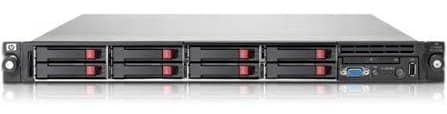
HPE ProLiant DL360
A dense 1U dual-socket server for high-density enterprise compute.
- High rack density
- Proven HPE management
- Efficient operations
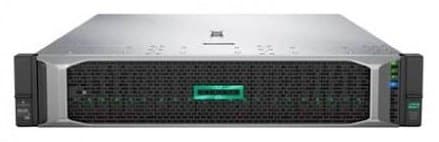
HPE ProLiant DL380
The versatile 2U enterprise standard, among the most deployed servers in the world.
- Versatile and proven
- Expansion headroom
- Mature management
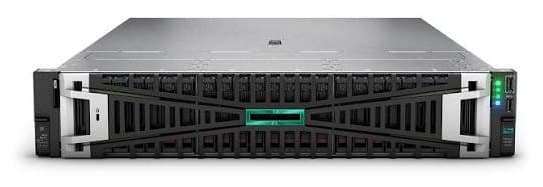
HPE ProLiant DL385
AMD EPYC performance and core density in a versatile 2U platform.
- Exceptional core density
- Strong memory bandwidth
- Licensing efficiency
HPE ProLiant DL320 Gen11 Single-Socket Edge Server
Compact single-socket 1U server tuned for edge and entry workloads.
- Right-sized footprint
- Low power draw
- Remote manageability
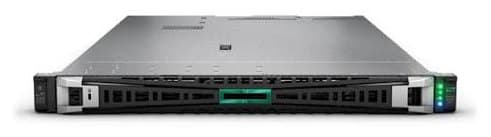
HPE ProLiant DL360 Gen11 with 4x NVIDIA L4
Dense 1U inference node for low-latency AI at the edge.
- Inference density
- Energy-efficient AI
- Operational consistency
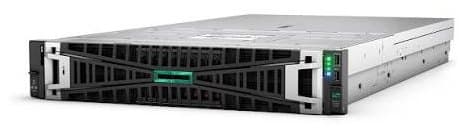
HPE ProLiant DL380 Gen11 with 2x NVIDIA H100 NVL
Versatile 2U GPU node for LLM inference and fine-tuning.
- Large-model capacity
- Flexible 2U platform
- Familiar HPE operations
HPE ProLiant DL380a Gen11 with 4x NVIDIA H100
Purpose-built 4-GPU 2U server for serious AI training.
- Training-class acceleration
- Purpose-built airflow
- Cluster-ready networking
HPE ProLiant DL385 Gen11 with 2x NVIDIA L40S (EPYC)
AMD EPYC plus dual L40S for visual computing and fine-tuning.
- Balanced AI and graphics
- High CPU core density
- Versatile expansion
HPE ProLiant DL345 Gen11 Single-Socket EPYC Storage Server
Single-socket EPYC 2U server built for storage-dense workloads.
- Storage capacity
- Single-socket efficiency
- Strong memory bandwidth
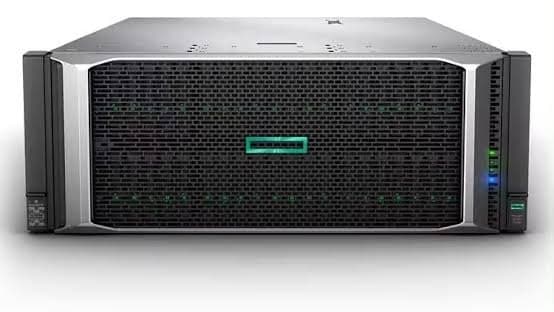
HPE ProLiant DL580 Gen11 4-Socket In-Memory Server (6TB DDR5)
Four-socket scale-up power for the largest in-memory databases.
- Massive in-memory headroom
- Scale-up consolidation
- Mission-critical resilience
HPE ProLiant DL580 Gen11 4-Socket Server with 3x NVIDIA H100
Scale-up CPU and triple H100 acceleration in one 4U chassis.
- Balanced CPU-GPU compute
- Dense acceleration
- Enterprise-grade reliability
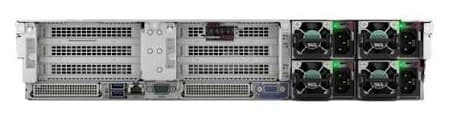
HPE ProLiant DL560 Gen11 4-Socket 2U Server with 2x NVIDIA L40S
Four sockets and dual L40S acceleration in a dense 2U.
- High density per U
- Versatile acceleration
- Consolidation economics
HPE ProLiant DL560 Gen11 4-Socket Virtualization Host (8TB DDR5)
Dense four-socket virtualization with 8TB memory in 2U.
- Higher VM density
- Lower per-VM overhead
- Compact footprint
HPE ProLiant ML350 Gen11 Tower with 2x NVIDIA L40S
Office-quiet tower with dual L40S for on-prem and edge AI.
- Deploys anywhere
- Practical AI acceleration
- Room to grow
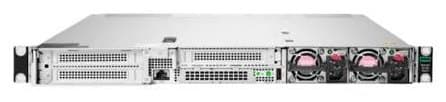
HPE ProLiant DL110 Gen11 Telco (Xeon vRAN Boost, NEBS Level 3)
Carrier-grade 1U edge compute purpose-built for 5G vRAN.
- Carrier-grade reliability
- Lower vRAN power draw
- Standards-based openness
HPE ProLiant DL110 Gen11 Edge AI (4x NVIDIA L4 24GB)
Compact 1U edge server tuned for low-latency AI inference.
- Efficient inference density
- Edge-ready footprint
- Validated and supported
What we need to quote accurately
A configuration quote takes minutes when these are known and days of back-and-forth when they are not. You do not need all of them to start. Send what you have.
- The workload: model sizes, training or inference, and expected concurrency
- Node count, and whether this is a single system or a scaling cluster
- Rack power and cooling available per rack, and inlet temperature
- Existing estate: the vendor and management tooling you already run
- Network fabric: InfiniBand, Ethernet, and the speed you are standardised on
- Timeline, and whether the budget is approved or being built
How we quote
- 1
Send the requirement
An email, a bill of materials, or a rough description of the workload. All three work.
- 2
We validate the configuration
Accelerator, chassis, fabric, power and cooling checked against each other before anything is priced.
- 3
Itemised quote within 48 hours
Line-by-line pricing, current availability and lead time, with warranty terms stated.
HPE ProLiant supplier: buyer questions
DL360 or DL380: how do we choose?
Almost always by expansion, not by processor. The DL360 is the 1U model and it is the right answer when you need rack density and the node is a hypervisor host with network and boot storage. The DL380 is the 2U model and you move to it when you need more drive bays, more or larger PCIe cards, or the airflow headroom that comes with the extra rack unit. If you are unsure, count the cards and the drives you actually need in eighteen months rather than today, because that is the number that decides it.
When does a four-socket DL560 or DL580 make sense?
When the binding constraint is memory capacity per node rather than core count. Consolidation targets and in-memory databases are the usual cases: you are buying sockets to get memory channels, and the licensing arithmetic often still favours fewer, larger nodes. The DL560 is the 2U four-socket model and the DL580 the 4U one; the difference between them is expansion and drive capacity. Below that threshold a pair of dual-socket DL380s is normally cheaper to buy and to run.
Can you supply ProLiant with the right iLO tier and support level?
Yes, and they belong on the same quote as the chassis. iLO Advanced licensing, the support tier and term, rails and cable management, network adapters and optics, and the drive and controller configuration are all specified together. We confirm the full build back to you in writing before the order goes in.
Do you supply HPE's GPU and HPC platforms?
Yes, the Cray XD670 and XD675 and the Apollo 6500 family are all sourceable through us. They are not on this page because they are not general-purpose servers: an eight-way SXM node needs its rack power, cooling and InfiniBand fabric designed alongside it, and quoting one as a line item next to a DL360 does the buyer no favours. Tell us the workload and we will scope the platform properly.
Compare with other platforms
Dell PowerEdge
Dell PowerEdge Rack & Tower Servers
View systemsLenovo ThinkSystem
Lenovo ThinkSystem Rack & Tower Servers
View systemsSupermicro
Supermicro Twin, Blade & Storage Servers
View systemsPricing
AI server price: what actually drives the number
View systemsBrowse the full range of GPU servers and AI clusters, or the component catalogue for drives, memory, optics and spares.