
8 GPU AI Server
High-density GPU compute for serious training and production inference workloads.
We help you choose, configure, and deliver the right system. No obligation.
Configuration at a Glance
Tailored per engagement. Full technical overview below.
Configuration Options
Core specifications for this system. Every component is configurable to your workload, so request a quote for a tailored build.
8× GPUs (H100 / H200 / B200 / RTX PRO, configurable)
Dual AMD EPYC or Intel Xeon
Up to 2TB+ ECC
High-throughput NVMe array
Overview
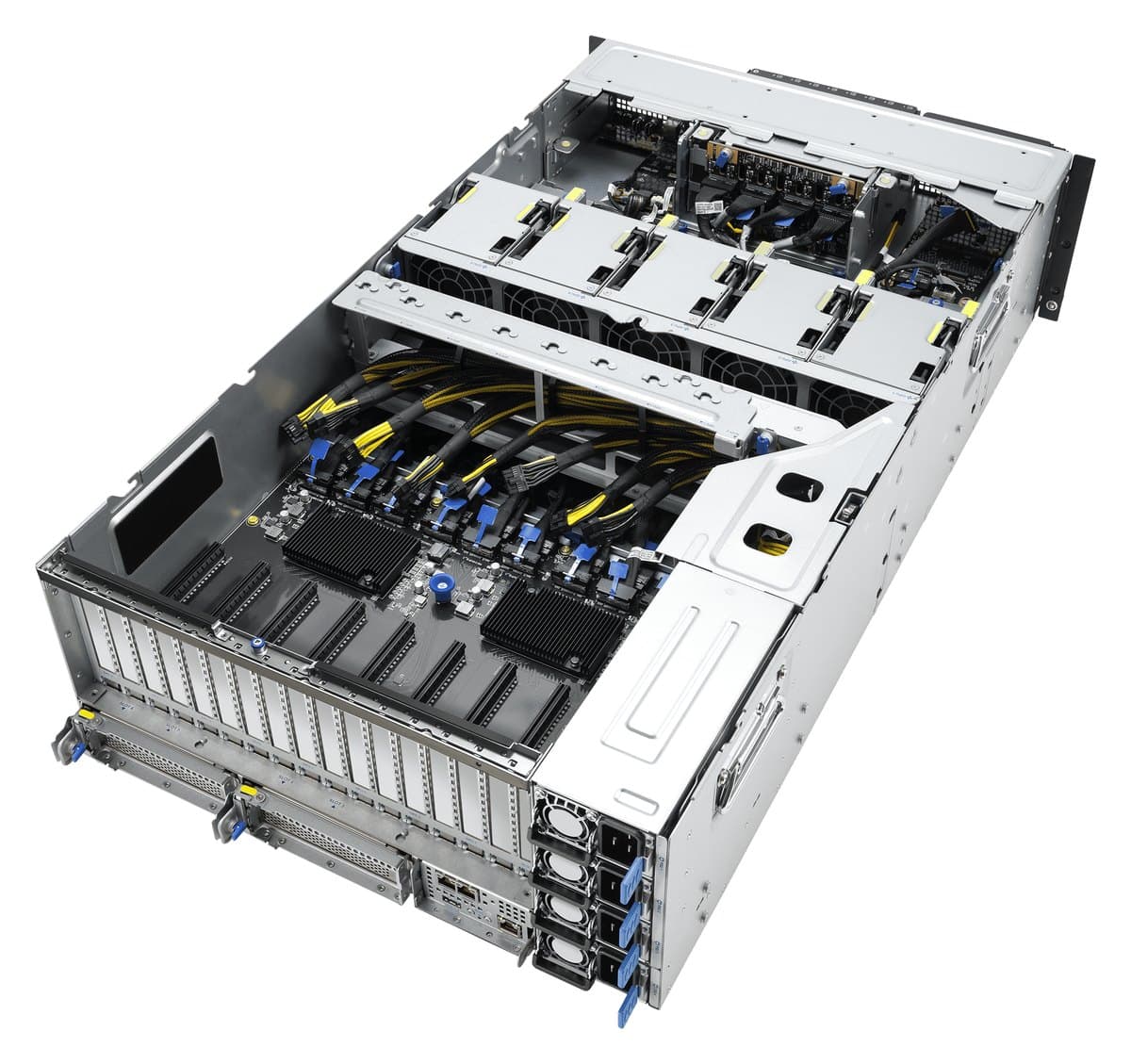
The 8 GPU AI Server delivers the GPU density required for large-model training and high-throughput inference in a single node. Nexus Compute sources these systems with the high-bandwidth GPU interconnect and supporting power, cooling, and networking that production AI workloads demand. Eight accelerators sharing an NVLink or NVSwitch domain behave, to most frameworks, like one large pool of memory: an 80GB-class part gives roughly 640GB aggregate, which is where training runs in the tens of billions of parameters stop needing to spill across machines. Below that boundary plain data parallelism is enough; at it you begin combining tensor and pipeline parallelism inside the node; beyond it you add nodes, and the fabric between them starts to set the pace of the run. The constraint is rarely the GPUs. An eight-way air-cooled node is typically a 10kW-and-up rack proposition, which is more than many server rooms can deliver or cool in a single rack, so establishing what your facility can actually supply per rack is the first question we ask.
Who This Solution Is For
Business Benefits
Train and serve at scale
Eight tightly-coupled GPUs handle workloads that single- or quad-GPU systems cannot, in one manageable node.
High-bandwidth interconnect
We specify NVLink/NVSwitch or InfiniBand so the GPUs work together efficiently on large models.
Production-grade infrastructure
Redundant power, enterprise cooling, and remote management suit always-on production use.
Foundation for a cluster
A single 8-GPU node is the building block of our multi-node training and inference clusters.
Typical Business Use Cases
Large language model fine-tuning and training
High-throughput production inference serving
Multi-user research compute consolidation
The first node of a scalable AI cluster
Single-node training where the model fits within aggregate GPU memory
Checkpoint-heavy fine-tuning requiring fast local NVMe
Industry Applications
Technical Overview
A purpose-built 8-GPU platform with high-bandwidth GPU interconnect, dual high-core-count CPUs, multi-terabyte ECC memory, high-speed networking, and redundant power. GPU selection spans data-center options including H100, H200, and B200. The two CPU sockets are there to feed the accelerators rather than to compute: the working rule is roughly eight to sixteen cores per GPU and system memory of one and a half to two times aggregate GPU memory, so preprocessing, checkpointing, and pinned host buffers do not throttle the training loop. Checkpoint writes are the storage requirement most often underestimated, because an eight-GPU node periodically writing model and optimizer state needs a local NVMe tier able to absorb it in seconds rather than minutes, with shared and bulk capacity behind it, which is covered under /products/storage. For multi-node use the fabric is specified at the same time as the node: large-scale training generally wants one RDMA-capable port per GPU on a non-blocking topology, and adding that later means changing adapters and re-cabling the rack. Fabric options are set out under /products/networking.
| GPU Capacity | 8× GPUs (H100 / H200 / B200 / RTX PRO, configurable) |
| GPU Interconnect | NVLink / NVSwitch or InfiniBand fabric |
| CPU | Dual AMD EPYC or Intel Xeon |
| System Memory | Up to 2TB+ ECC |
| Storage | High-throughput NVMe array |
| Networking | 100/400GbE or InfiniBand |
| Power | Redundant high-capacity PSUs |
| Form Factor | 4U–8U rackmount |
| GPU Memory (H100 SXM option) | 640GB HBM3 total (8x 80GB) |
| NVSwitch Bandwidth (H100 SXM option) | 900GB/s GPU-to-GPU, 7.2TB/s aggregate |
| FP8 Performance (H100 SXM option) | 32 PFLOPS with sparsity |
Specifications are indicative and configured to each engagement. Request a quote for a configuration tailored to your requirements.
Warranty, Support & Fulfillment
Every system ships from an authorized channel, configured and tested, with the documentation enterprise buyers need: genuine product, backed by the full manufacturer warranty.
Enterprise Warranty
Full manufacturer warranty with optional on-site, next-business-day support and extended coverage.
Authorized Channel
Sourced through Tier-1 distribution and OEM partners (never grey market). Asset & warranty records included.
Lead Time & Deployment
48-hour quotes, then configured, burn-in tested, and delivered on a committed schedule.
Nationwide Fulfillment
Coordinated logistics, rack-and-stack, and delivery wherever your infrastructure lives.
Frequently Asked Questions
What power and cooling does an 8-GPU server need?
These are high-power systems best deployed in a data center or properly provisioned server room. We confirm exact power and cooling requirements and can advise on colocation.
NVLink/NVSwitch or InfiniBand: which do I need?
For tightly-coupled single-node training, NVLink/NVSwitch is ideal. InfiniBand becomes important when scaling across multiple nodes. We specify based on your roadmap.
Can you help with installation?
We coordinate delivery and can advise on installation and commissioning through our sourcing process.
What lead time and allocation should we expect?
Current-generation data-center GPUs are allocated rather than stocked, so availability is a point-in-time answer that we confirm at quote and again before order. Chassis, CPUs, memory, and networking are generally shorter lead items, which means the accelerator usually sets the date. Where a deadline is firm, we will say plainly whether a different GPU generation makes it achievable.
How does it scale to more nodes?
By adding nodes onto a fabric that was specified for the eventual size rather than the first purchase. Once a model no longer fits in one node, the interconnect between nodes sets the training rate, so large-scale builds want RDMA-capable adapters, a switch with enough non-blocking ports for the final node count, and matched cabling and optics. Nodes bought without that can still be clustered, usually at lower efficiency and with hardware that has to be replaced.
Air or liquid cooling?
Air-cooled eight-way nodes are well understood and deployable in a conventional data hall, but they concentrate a rack-scale electrical load into one chassis, so density often falls to one or two nodes per rack. Direct-to-chip liquid cooling raises that ceiling considerably, at the cost of requiring coolant distribution, a secondary loop, and leak handling in the building. Which is right is a property of your facility rather than of the server.
Hardware Assistance
Configure the 8 GPU AI Server with Nexus Compute
Tell us your requirements and a hardware specialist will help you specify, configure, and quote the right system, typically within two business days. No obligation.