
4 GPU AI Server
An entry-point rackmount AI server for teams moving beyond the workstation.
We help you choose, configure, and deliver the right system. No obligation.
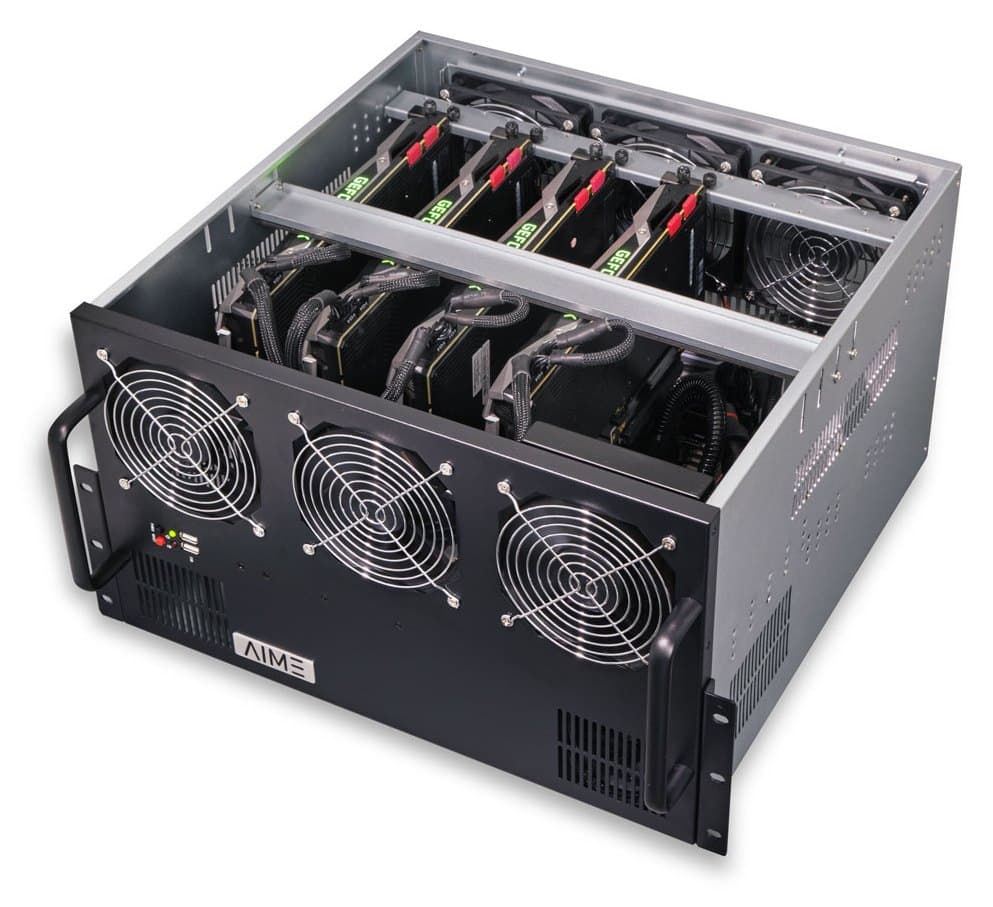
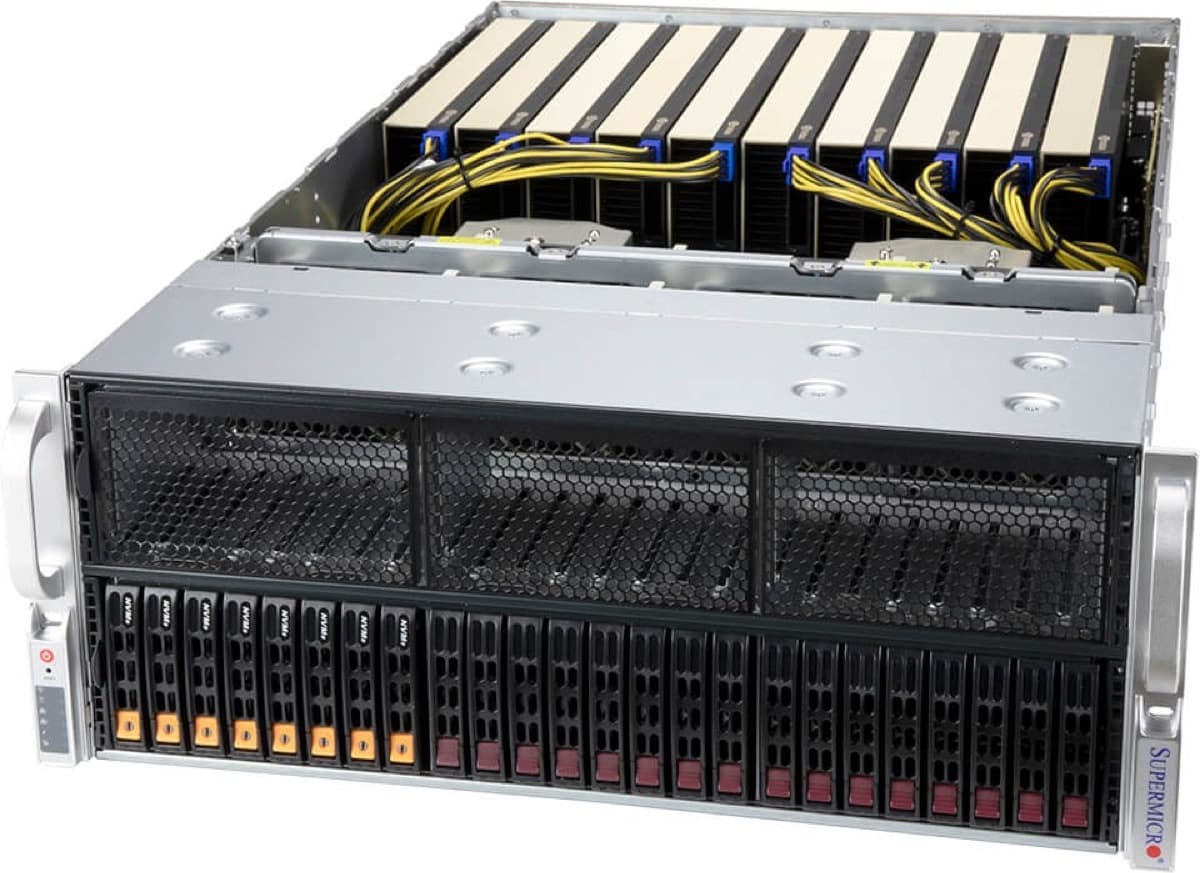
Configuration at a Glance
Tailored per engagement. Full technical overview below.
Configuration Options
Core specifications for this system. Every component is configurable to your workload, so request a quote for a tailored build.
4× GPUs (RTX 5090 / RTX PRO / H100 PCIe, configurable)
Dual AMD EPYC or Intel Xeon
Up to 1.5TB ECC
Hot-swap NVMe (configurable capacity)
Overview
The 4 GPU AI Server is the natural next step for teams that have outgrown desktop GPUs and need rack-mounted, manageable, always-on compute. Nexus Compute specifies the GPU type, interconnect, and supporting infrastructure to your workload, then sources and configures the complete system for deployment in your facility or colocation. Four accelerators is the point at which a team stops contending for a desktop card and starts scheduling shared work: fine-tuning models in the single- to low-double-digit billions of parameters, serving several production endpoints, or giving four developers an independent GPU each. The ceiling is the node itself: with no cluster fabric, whatever you run has to fit inside the combined memory of those four cards, or be quantized or offloaded to do so. Power is usually the constraint that decides the configuration rather than budget. An RTX-class build sits in the low single-digit kilowatts, while four data-center cards plus host overhead can consume most of a standard rack feed. We size the host CPU, system memory, and NVMe against the accelerators chosen, so the GPUs are not left waiting on the data path.
Who This Solution Is For
Business Benefits
Shared, always-on compute
A rack server serves the whole team continuously, replacing contended desktop GPUs and idle cloud instances.
Configured to your workload
We match the GPU choice (from RTX to data-center cards) to whether you train, fine-tune, or serve.
Manageable and remote
Out-of-band management and rack form factor fit standard IT operations and remote administration.
A clear scaling path
Start at four GPUs and grow into our 8-GPU and cluster solutions as demand increases.
Typical Business Use Cases
Shared team training and fine-tuning workloads
Production inference serving for internal applications
Consolidating GPU access across multiple developers
On-premises pilots before committing to a cluster
Fine-tuning and adapter training on models that fit within four accelerators
Scheduled multi-user access via Slurm or Kubernetes
Industry Applications
Technical Overview
A 4U dual-socket platform supporting four GPUs (configurable from RTX-class to data-center cards) with high-core-count CPUs, large ECC memory, redundant power, and out-of-band management. We finalize GPU and interconnect choices with you. Host sizing follows the accelerators rather than a fixed template: as a working rule, allow roughly eight to sixteen CPU cores per GPU for data loading and preprocessing, and system memory of about one and a half to two times aggregate GPU memory so datasets and pinned buffers have somewhere to live. Local NVMe sits in front of any shared or bulk storage as a scratch and dataset-cache tier, because a training loop that reads across the network at every step will stall the GPUs; shared and bulk tiers are covered under /products/storage. Networking is specified against intent: 25GbE is adequate for a standalone node serving inference, whereas a node meant to join a cluster later needs an RDMA-capable adapter and a compatible fabric chosen at purchase rather than retrofitted, which is set out under /products/networking.
| GPU Capacity | 4× GPUs (RTX 5090 / RTX PRO / H100 PCIe, configurable) |
| CPU | Dual AMD EPYC or Intel Xeon |
| System Memory | Up to 1.5TB ECC |
| Storage | Hot-swap NVMe (configurable capacity) |
| Networking | 25/100GbE; InfiniBand optional |
| Management | IPMI / out-of-band remote management |
| Power | Redundant N+1 power supplies |
| Form Factor | 4U rackmount |
| GPU Memory (H100 PCIe option) | 80GB HBM2e, 2.0 TB/s bandwidth |
| Max GPU TDP (H100 PCIe option) | 350W |
| GPU Interconnect (H100 PCIe option) | NVLink bridge (2-GPU, 600GB/s) or PCIe Gen5 x16 |
| Chassis Dimensions (representative 4U platform) | 7in H x 17.2in W x 29in D (178 x 437 x 737mm) |
| PSU Configuration (representative) | 4x 2700W (2+2) redundant, Titanium (96%) |
Specifications are indicative and configured to each engagement. Request a quote for a configuration tailored to your requirements.
Warranty, Support & Fulfillment
Every system ships from an authorized channel, configured and tested, with the documentation enterprise buyers need: genuine product, backed by the full manufacturer warranty.
Enterprise Warranty
Full manufacturer warranty with optional on-site, next-business-day support and extended coverage.
Authorized Channel
Sourced through Tier-1 distribution and OEM partners (never grey market). Asset & warranty records included.
Lead Time & Deployment
48-hour quotes, then configured, burn-in tested, and delivered on a committed schedule.
Nationwide Fulfillment
Coordinated logistics, rack-and-stack, and delivery wherever your infrastructure lives.
Frequently Asked Questions
Which GPU should I choose?
It depends on your workload. Training and large-model work favor data-center GPUs; cost-sensitive inference and development can use RTX-class cards. Our specialists recommend the right fit during your quote.
Do I need a data center to host it?
It can run in a server room with adequate power and cooling, or we can advise on colocation. We confirm facility requirements as part of the quote.
Can it join a cluster later?
Yes. We specify networking that allows it to be incorporated into a larger cluster as your needs grow.
What lead time should I expect?
RTX-class configurations are normally the quickest to ship. Data-center accelerators are allocation-based and their availability moves with supply, so we quote a realistic date rather than an optimistic one, and tell you when a different GPU choice would materially shorten it. If your deadline is fixed, say so at enquiry and we work backwards from it.
Does it arrive configured and burned in?
Yes. Systems are assembled, thermally validated under load, and burn-in tested before shipping, with the operating system, GPU drivers, and CUDA stack installed to your specification. We coordinate delivery and can arrange rack-and-stack, or hand over a node your own facility team racks, along with the asset and warranty records procurement usually asks for.
What if our server room cannot supply the power or cooling?
This is the most common late discovery on a first rack deployment. The node needs a dedicated high-amperage circuit and enough cooling capacity to remove its full electrical load as heat, with the airflow direction the rack expects. If the room cannot do that, the practical answers are a lower-power GPU choice, splitting the load across circuits and racks, or colocation. We work through it before the order rather than after delivery.
Hardware Assistance
Configure the 4 GPU AI Server with Nexus Compute
Tell us your requirements and a hardware specialist will help you specify, configure, and quote the right system, typically within two business days. No obligation.