
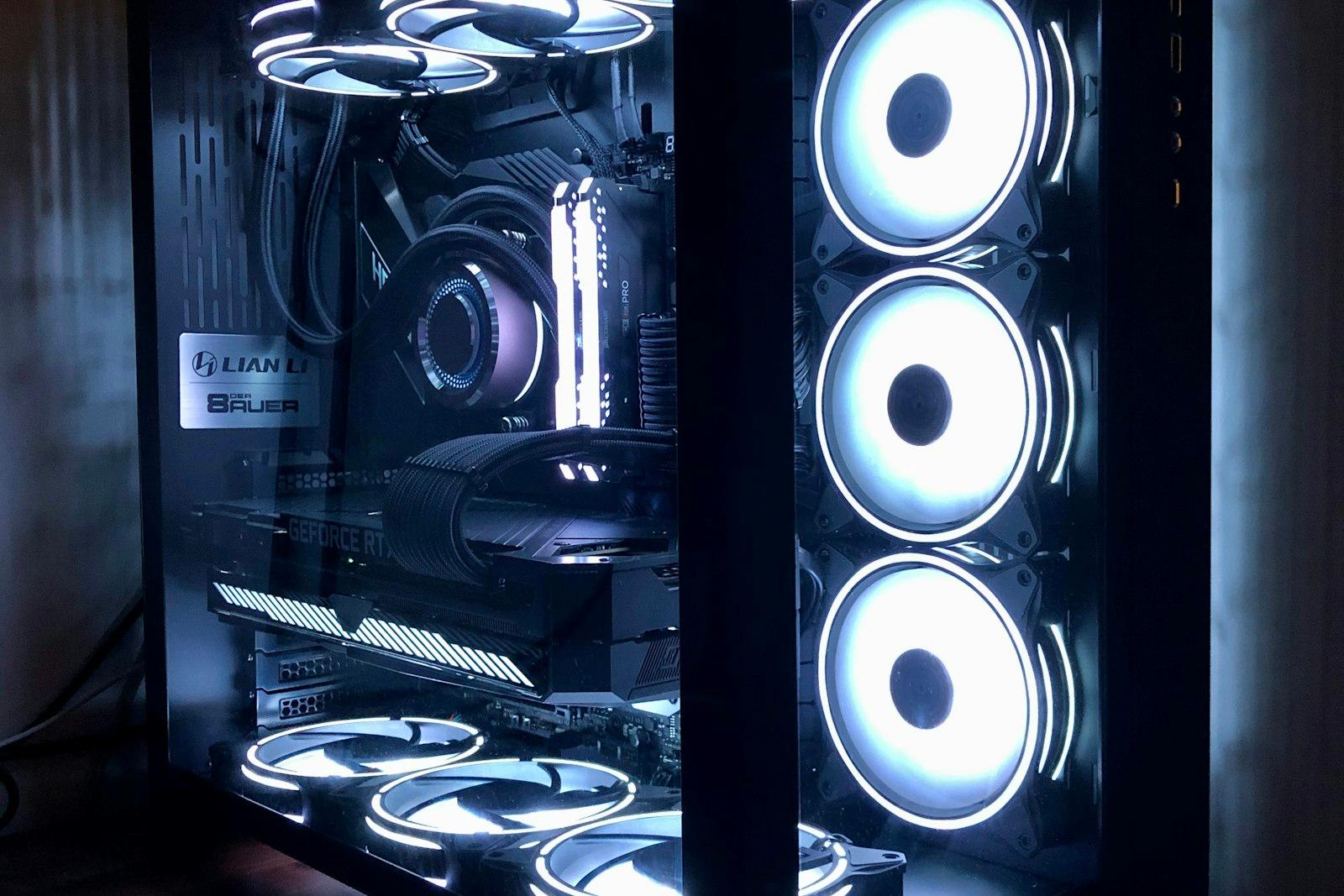
What Hardware Do You Need to Run Local LLMs in Late 2026?
Memory decides which local LLM fits and bandwidth decides its speed. Here is what 32GB, 128GB, 512GB and an 8-GPU node can each run in late 2026.
The hardware you need to run a local LLM in late 2026 depends mainly on how much memory the model needs. A 24-32GB GPU handles capable small models, 64-128GB reaches the mid-size class, 256-512GB holds compressed versions of very large models, and the biggest open models need an 8-GPU server. Decide which model you need first, then buy the memory tier that fits it. For the sizing method itself, see our guide to VRAM sizing for LLMs. This post maps today's models to today's hardware.
What matters most for running LLMs locally?
Memory capacity decides whether a model loads at all, and memory bandwidth largely decides how fast it generates text. The difference between platforms is large. DGX Spark offers 128GB of unified memory at 273 GB/s (NVIDIA), Mac Studio with M5 Ultra offers up to 512GB at 1.2TB/s (Apple), and the RTX PRO 6000 Blackwell offers 96GB at 1,792 GB/s (NVIDIA). Two more details affect the budget. Many large models use a mixture-of-experts design, so memory follows total parameters while each token only uses some of them: Qwen3.6-35B-A3B has 35 billion parameters in total and 3 billion active (Hugging Face). Context also needs memory beyond the weights. Alibaba's Qwen team advises reducing the context window if you run out of memory, but keeping at least 128K tokens for complex tasks. The file sizes below are therefore minimums, and you should leave headroom.
What can you run on 24-32GB of memory?
This is the entry tier for useful local AI, and the GeForce RTX 5090 with 32GB of GDDR7 is the obvious single-GPU option. File sizes below are 4-bit (Q4_K_M) downloads listed on Hugging Face on November 6, 2026.
- gpt-oss-20b: about 12GB, and OpenAI says the model runs within 16GB of memory (Hugging Face).
- Qwen3.6-27B: about 17GB.
- Gemma 4 31B: about 18GB.
- Qwen3.6-35B-A3B: about 22GB, which fits a 24GB card only with a modest context window.
A 32GB card leaves more room for context than a 24GB card, and that margin matters more than it looks for coding agents and long documents. Our RTX 5090 guide covers the workstation build.
What can you run on 64-128GB of memory?
This tier reaches models such as gpt-oss-120b, which is about 63GB in 4-bit form (Hugging Face) and which OpenAI says fits a single 80GB GPU (Hugging Face). Three platforms compete here.
- RTX PRO 6000 Blackwell: 96GB of ECC GDDR7 at 1,792 GB/s and up to 600W (NVIDIA). This is the speed choice, and it runs the full CUDA stack in a standard workstation.
- DGX Spark: 64GB or 128GB of unified memory at 273 GB/s, with the 64GB version sold through OEM partners (NVIDIA). NVIDIA rates one 128GB unit for models up to 200 billion parameters. The Founders Edition list price rose from $3,999 to $4,699 on February 23, 2026, which NVIDIA attributed to memory supply constraints (NVIDIA).
- Mac Studio with M5 Max: up to 128GB of unified memory at 614GB/s (Apple). This offers strong bandwidth for a unified memory system, but Apple hardware does not run CUDA, so check your software stack first.
What can you run on 256-512GB of memory?
This tier opens up very large models, but mostly in compressed form. DeepSeek-V4-Flash is about 160GB as published (Hugging Face), so it fits comfortably. GLM-5.2 is about 466GB at Q4_K_M (Hugging Face) and Qwen3.5-397B is about 488GB (Hugging Face), so a 512GB machine can hold either one on paper with little left for context.
- Mac Studio with M5 Ultra: 256GB or 512GB at 1.2TB/s (Apple). This is the simplest single box at this capacity.
- Linked DGX Spark units: NVIDIA rates two 128GB units for up to 400 billion parameters and four units with 512GB for up to 700 billion (NVIDIA). Expect interconnect overhead and the same 273 GB/s per unit.
- DGX Station: 748GB of coherent memory on the GB300 superchip (NVIDIA). Our DGX Station vs DGX Spark comparison explains how that memory splits between GPU and CPU.
- Multi-GPU workstation: two RTX PRO 6000 cards give 192GB and four give 384GB, split across cards, at up to 2,400W for the GPUs alone. Read our power supply sizing guide before you plan a four-card build.
What do the largest open-weight models need?
The largest open models are server workloads, not desktop ones. Kimi K3 has 2.8 trillion total parameters and 104 billion active, and its published weights total about 1.56TB in native MXFP4 (Hugging Face). DeepSeek-V4-Pro totals about 865GB (Hugging Face). GLM-5.2 is about 1.5TB at full precision (Hugging Face).
Compare those sizes with 8-GPU systems. A DGX H100 provides 640GB of total GPU memory and a DGX H200 provides 1,128GB (NVIDIA), while a DGX B300 provides 2.1TB (NVIDIA). DeepSeek-V4-Pro fits an H200 node on paper, and Kimi K3 needs a B300-class node or several servers. Moonshot recommends vLLM, SGLang or TokenSpeed for Kimi K3, which points to a serving cluster rather than a workstation. These comparisons cover weights only, so test with your real context length and concurrency. Our guide to how many GPUs an AI server needs goes further.
Should you pick a GPU, unified memory or DGX Spark?
Choose by what you are optimizing for. Keep concurrency in mind, because serving several users at once takes more memory and compute than one person using the same model, and each active session holds its own context.
- Pick a discrete GPU when speed, multiple users or CUDA software matter. It is also the path that scales to servers.
- Pick DGX Spark when you want NVIDIA software on your desk and a large model is more important than fast output.
- Pick Mac Studio when you want the largest single memory pool for one user and your tools already support Apple silicon.
- Pick an 8-GPU server when several people or applications share the model, or when you need the largest open models.
When is local hardware the wrong answer?
Local hardware is the wrong answer when usage is light or unpredictable, because an API or rented GPU will often cost less. It is the better answer when data must stay on your premises, when usage is high and steady, or when you need predictable latency. Our local versus cloud cost framework shows how to test that. Memory pricing is also working against buyers: TrendForce said on September 30, 2026 that GDDR7 output remains limited as advanced capacity goes to server DRAM (TrendForce). Check licenses as well. DeepSeek-V4 and GLM-5.2 are tagged MIT, Qwen and gpt-oss are Apache 2.0, and Kimi K3 uses its own Kimi K3 License, so have counsel read it before commercial use.
Nexus Compute supplies new AI workstations, GPUs and GPU servers through authorized distribution channels with the full manufacturer warranty. We check compatibility against your platform before dispatch and quote within 48 business hours, with purchase orders and net terms for qualified organizations. Request a quote or email sales@nexus-compute.com with the models you plan to run and the number of users you need to serve.
Frequently asked questions
How much memory do you need to run an LLM locally?
Local LLM memory needs depend on the model size and compression level. A 4-bit copy of Qwen3.6-35B-A3B is about 22GB on Hugging Face, while a 4-bit copy of GLM-5.2 is about 466GB. Context needs additional memory on top of those file sizes, so leave headroom.
Can DGX Spark run large open-weight models?
DGX Spark can load large open-weight models, but its 273 GB/s memory bandwidth limits speed. NVIDIA rates one 128GB unit for models up to 200 billion parameters and four linked units for up to 700 billion, according to its DGX Spark page. DGX Spark suits development and testing better than serving many users.
Is an RTX PRO 6000 or a Mac Studio better for local LLMs?
An RTX PRO 6000 is the better choice for speed and CUDA software, with 96GB of memory at 1,792 GB/s according to NVIDIA. A Mac Studio with M5 Ultra is the better choice for capacity, with up to 512GB at 1.2TB/s according to Apple. The right pick depends on whether your model fits in 96GB.
Can you run Kimi K3 on a workstation?
Kimi K3 is not a practical workstation model, because its published weights total about 1.56TB on Hugging Face. That exceeds the 748GB of coherent memory in a DGX Station and the 1,128GB of GPU memory in a DGX H200. Kimi K3 is better served on a B300-class node or a multi-server cluster.
What is the best GPU for running LLMs locally?
The best GPU for local LLMs is the one whose memory holds your model with room for context. The 32GB RTX 5090 suits small models, and the 96GB RTX PRO 6000 reaches mid-size models such as gpt-oss-120b. Models above that size usually need several GPUs or a server.
Sources
Figures in this article are attributed to the sources below, as reported on the dates cited. Prices and availability change quickly; confirm current figures before you buy.
- Hugging Face: Kimi K3 (huggingface.co)
- NVIDIA: Dgx spark (nvidia.com)
- Apple (apple.com)
- NVIDIA: Rtx pro 6000 (nvidia.com)
- Hugging Face: Qwen3.6 35B A3B (huggingface.co)
- GeForce RTX 5090 (nvidia.com)
- gpt-oss-20b (huggingface.co)
- Hugging Face: Gpt oss 120b (huggingface.co)
- Qwen3.6-27B (huggingface.co)
- Gemma 4 31B (huggingface.co)
- Qwen3.6-35B-A3B (huggingface.co)
- Hugging Face: Gpt oss 120b GGUF (huggingface.co)
- NVIDIA: 2 23 2026 price change announcement (forums.developer.nvidia.com)
- Hugging Face: DeepSeek V4 Flash (huggingface.co)
- Hugging Face: GLM 5.2 GGUF (huggingface.co)
- Hugging Face: Qwen3.5 397B A17B GGUF (huggingface.co)
- NVIDIA: Dgx station (nvidia.com)
- Hugging Face: DeepSeek V4 Pro (huggingface.co)
- Hugging Face: GLM 5.2 (huggingface.co)
- NVIDIA: Introduction to dgxh100 (docs.nvidia.com)
- NVIDIA: Dgx b300 (nvidia.com)
- TrendForce (trendforce.com)
Systems covered in this article
Planning a hardware investment?
Tell us what you're trying to build. A procurement specialist will help you specify and quote the right configuration within 48 business hours, no obligation.