
HBM4 Explained: What It Means for Vera Rubin and Server Memory
HBM4 doubles the memory interface and feeds Vera Rubin. It also takes far more DRAM wafers than bits it delivers, which keeps ordinary server RAM tight.
HBM4 is the latest generation of high-bandwidth memory, the stacked DRAM that sits next to an AI accelerator and feeds it data. It matters because Vera Rubin relies on it, and because making it takes DRAM wafers that would otherwise become ordinary server memory. You will not buy HBM4 directly, but it shapes GPU server pricing and RDIMM availability. This guide explains the technology, where the three suppliers stood in late October 2026, and what that means for your budget.
What is HBM4?
HBM stacks DRAM dies vertically on a base die and connects the stack to the processor through a very wide interface. The JEDEC HBM4 standard supports up to 8 Gb/s across a 2,048-bit interface, for up to 2 TB/s per stack, according to Tom's Hardware. The standard also doubles independent channels per stack from 16 in HBM3 to 32. It allows stacks from 4-high to 16-high, with capacity up to 64GB per stack using 32Gb dies.
How is HBM4 different from HBM3E?
The main change is width, and shipping parts run well above the 8 Gb/s JEDEC baseline. Figures below are supplier claims, not independent test results.
- Pin speed: Samsung says its HBM4 runs at a consistent 11.7 Gbps and can reach 13 Gbps, against a 9.6 Gbps maximum for its HBM3E (Samsung). Micron says its 36GB 12-high stack exceeds 11 Gb/s (Tom's Hardware).
- Bandwidth: Samsung claims a maximum of 3.3 TB/s per stack, 2.7 times its HBM3E. Micron claims more than 2.8 TB/s, a 2.3 times gain (Tom's Hardware).
- Capacity: Samsung offers 24GB to 36GB with 12-layer stacking and plans up to 48GB with 16 layers (Samsung).
- Base die: Samsung uses a 4nm logic process for its base die (Samsung), while Micron describes an in-house base die for HBM4 (Micron call transcript).
Why does HBM4 matter for Vera Rubin?
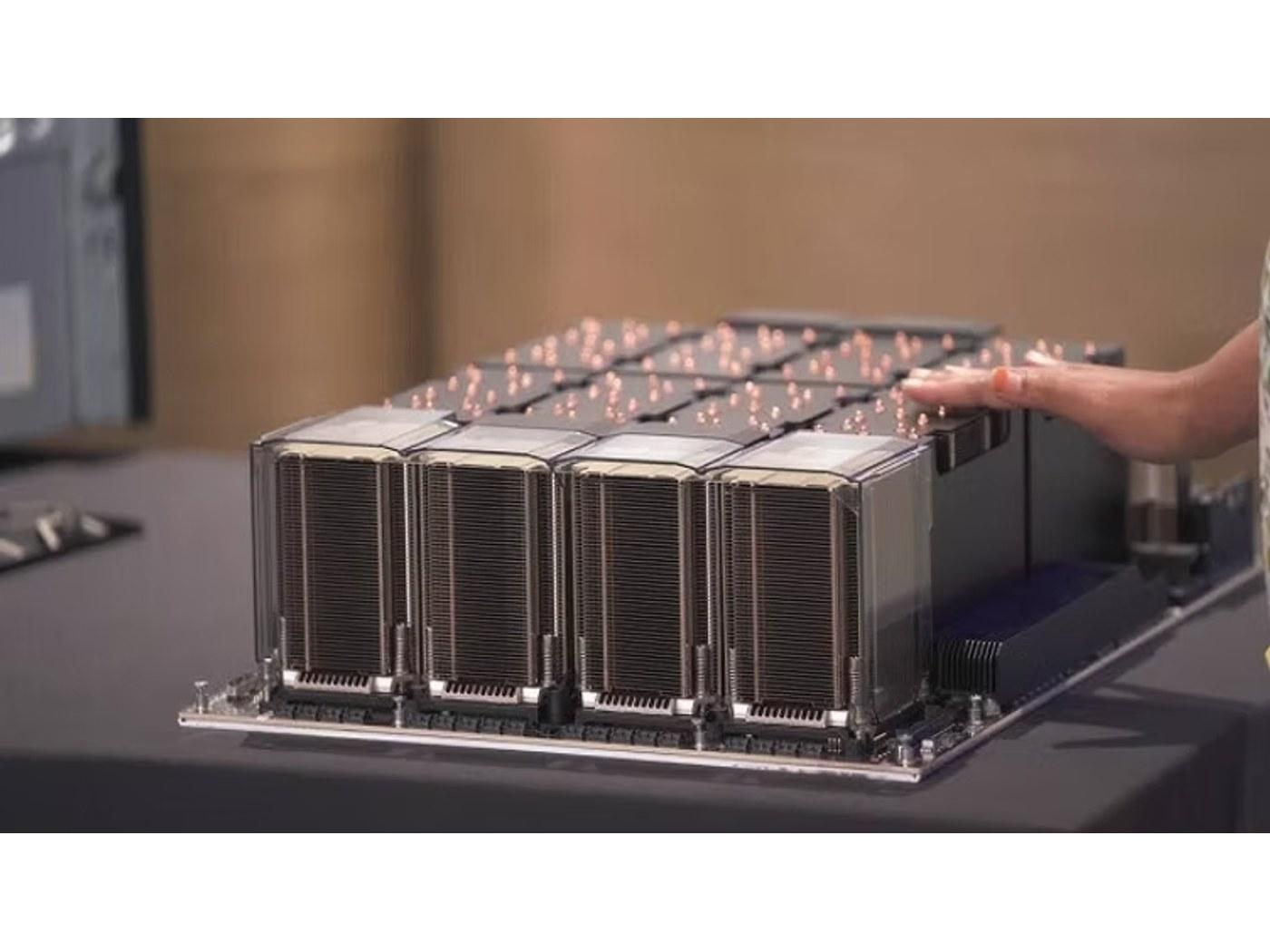
Each Rubin GPU carries 288GB of HBM4, and a Vera Rubin NVL72 rack carries 20.7TB across 72 GPUs (NVIDIA). That capacity equals eight 36GB stacks per GPU. TrendForce said in June 2026 that HBM capacity per GPU on Rubin would stay similar to the previous generation (TrendForce), so the gain from HBM4 is mainly bandwidth, not capacity. NVIDIA's own pages disagree on that bandwidth. On November 6, 2026, its NVL72 page listed 19.2 TB/s per GPU (NVIDIA), while its HGX page listed 22 TB/s (NVIDIA). Confirm the figure on your specific configuration before relying on it. On status, NVIDIA said in August 2026 that production shipments had begun that month (call transcript), and its product page describes Vera Rubin as ramping into full production. Our Vera Rubin buying guide covers timing for buyers.
Where do SK hynix, Samsung and Micron stand on HBM4?
All three suppliers are shipping 12-layer HBM4. Their latest public positions are below, and they come from the companies themselves. The MoneyToday reports are machine-translated, so treat the exact wording with some care.
- SK hynix: on October 28, 2026 it said 12-layer HBM4 shipments were on schedule and that HBM4 should pass HBM3E in shipments and revenue in the fourth quarter (MoneyToday). It plans to bring its M15X fab to full capacity by year-end. In August it said 16-layer HBM4 had entered customer qualification (Financial News).
- Samsung: it began mass production and shipped commercial HBM4 on February 12, 2026 (Samsung). On October 29 it said third-quarter HBM4 revenue had tripled from the prior quarter, reached 60% of its HBM revenue, and that next year's HBM supply is sold out (MoneyToday).
- Micron: it announced high-volume production of 36GB 12-high HBM4 for Vera Rubin in March 2026 and has shipped samples of a 48GB 16-high stack (Tom's Hardware). On its September 30 call it said HBM pricing was raised significantly for calendar 2027 (Micron call transcript).
Market share estimates for Rubin-bound HBM4 vary between trackers, so we have not quoted one here. Samsung did say that it appears to have reached its goal of matching its HBM share to its overall DRAM share in the third quarter (MoneyToday).
How does HBM demand affect ordinary server memory prices?
HBM affects server memory because it uses far more wafer capacity than the bits it delivers. TrendForce estimates HBM will account for about 22% of DRAM wafer input at the top three suppliers by the end of 2026 and about 30% by the end of 2027, against about 9% and 13% of DRAM bit supply (TrendForce). In other words, HBM takes more than twice the wafer share that its bit share suggests. Micron's Manish Bhatia said on the September 30 call that HBM should keep growing faster than conventional DRAM through 2028 and that newer generations carry higher trade ratios, which limits bit growth (Micron call transcript).
The relationship has also become two-way. TrendForce said DDR5 64GB RDIMM overtook HBM on revenue per wafer in the first quarter of 2026 (TrendForce). Suppliers now weigh HBM against server DRAM directly, so a strong RDIMM market pushes HBM prices up, and higher HBM prices keep capacity on HBM. Buyers of ordinary memory do not get relief from either direction. TrendForce forecast on September 30 that conventional DRAM contract prices would rise 10-15% in the fourth quarter of 2026, with server DRAM still undersupplied (TrendForce).
Will HBM4 prices fall in 2027?
Current forecasts point the other way. TrendForce projected on September 29, 2026 that blended HBM selling prices will rise 121% year over year in 2027 (TrendForce). That figure is a blended forecast that reflects product mix as well as price. SK hynix said its 2027 HBM terms were concluded and that the profitability gap with conventional DRAM should narrow significantly (MoneyToday). SK hynix also said HBM and other DRAM are sold out through 2029 and expects supply to fall short of demand through 2030, according to The Korea Times. One possible response is less memory per device. TrendForce reports that GPU and ASIC makers are considering 8-high stacks in place of 12-high in 2027 to lower cost, even though 8-high carries a premium of roughly 10-20% per gigabit (TrendForce). Check the memory configuration on any future accelerator, not only the model name.
What comes after HBM4?
HBM4E is next. Samsung said it began shipping 12-layer HBM4E samples on May 29, 2026, and SK hynix followed in June, both citing 48GB and 16 Gbps per pin (Korea Herald). Both had only shipped samples as of that June report. Micron says it is co-designing a custom HBM4E product with NVIDIA (Micron call transcript).
What should server buyers do about HBM4?
- Plan for high memory costs through 2027, in both GPU servers and general-purpose hosts.
- Treat GPU memory as a specification to confirm in writing, including stack configuration on new platforms.
- Right-size RDIMM capacity rather than copying a past build. Our guide to DDR5 memory population can help.
- Follow the market through our November DRAM price update and our guide to when server RAM prices will drop.
- If you can wait, wait only with a clear reason, because no supplier quoted here expects relief soon.
Nexus Compute supplies new server memory, GPUs and complete GPU servers through authorized distribution channels with the full manufacturer warranty. We check compatibility against your platform before dispatch and quote within 48 business hours, with purchase orders and net terms for qualified organizations. Request a quote or email sales@nexus-compute.com with your platform and capacity needs.
Frequently asked questions
What is HBM4?
HBM4 is the latest generation of high-bandwidth memory, a stacked DRAM placed beside AI accelerators. The JEDEC standard specifies a 2,048-bit interface and up to 2 TB/s per stack, according to Tom's Hardware. Shipping parts from Samsung and Micron are rated above that baseline.
What is the difference between HBM4 and HBM3E?
HBM4 has a wider interface and higher bandwidth than HBM3E. Samsung claims 11.7 Gbps and up to 3.3 TB/s per stack for HBM4, against a 9.6 Gbps maximum for its HBM3E, according to Samsung. These are supplier figures rather than independent test results.
How much HBM4 does Vera Rubin use?
Vera Rubin uses 288GB of HBM4 per Rubin GPU, and a Vera Rubin NVL72 rack carries 20.7TB in total, according to NVIDIA. NVIDIA's pages listed different bandwidth figures on November 6, 2026: 19.2 TB/s per GPU on the NVL72 page and 22 TB/s on the HGX page.
Why does HBM make server RAM more expensive?
HBM makes server RAM more expensive because it consumes scarce DRAM wafer capacity. TrendForce estimates HBM will take about 22% of DRAM wafer input by the end of 2026 while providing about 9% of bit supply, according to its June 2026 report. That leaves less capacity for conventional DRAM such as RDIMMs.
Who makes HBM4?
SK hynix, Samsung and Micron make HBM4, and all three said in 2026 that 12-layer parts were in production or shipping. Samsung announced mass production on February 12, 2026, according to Samsung. Micron announced high-volume production in March 2026, and SK hynix said in October that shipments were on schedule.
Sources
Figures in this article are attributed to the sources below, as reported on the dates cited. Prices and availability change quickly; confirm current figures before you buy.
- Tom's Hardware: Jedec finalizes hbm4 memory standard with major bandwidth and efficiency upgrades (tomshardware.com)
- NVIDIA: Vera rubin nvl72 (nvidia.com)
- Samsung (news.samsung.com)
- Tom's Hardware: Micron enters high volume production of hbm4 for nvidia vera rubin (tomshardware.com)
- Micron call transcript (webull.com)
- TrendForce: Release of 2 June 2026 (trendforce.com)
- NVIDIA: Data center (nvidia.com)
- call transcript (transcripts.platformaeronaut.com)
- MoneyToday: Release of 28 October 2026 (mt.co.kr)
- Financial News (en.fnnews.com)
- MoneyToday: Release of 29 October 2026 (mt.co.kr)
- TrendForce: Release of 30 September 2026 (trendforce.com)
- TrendForce: Release of 29 September 2026 (trendforce.com)
- The Korea Times (koreatimes.co.kr)
- Korea Herald (koreaherald.com)
Systems covered in this article
Planning a hardware investment?
Tell us what you're trying to build. A procurement specialist will help you specify and quote the right configuration within 48 business hours, no obligation.