PCIe Gen5 NVMe: What the New Standard Means for AI Storage
PCIe Gen5 NVMe doubles the interface bandwidth of Gen4, enabling sequential read speeds exceeding 14 GB/s per drive. For AI storage architects, this new standard reshapes what is achievable in direct-attached configurations and changes the performance calculus for dense storage servers.
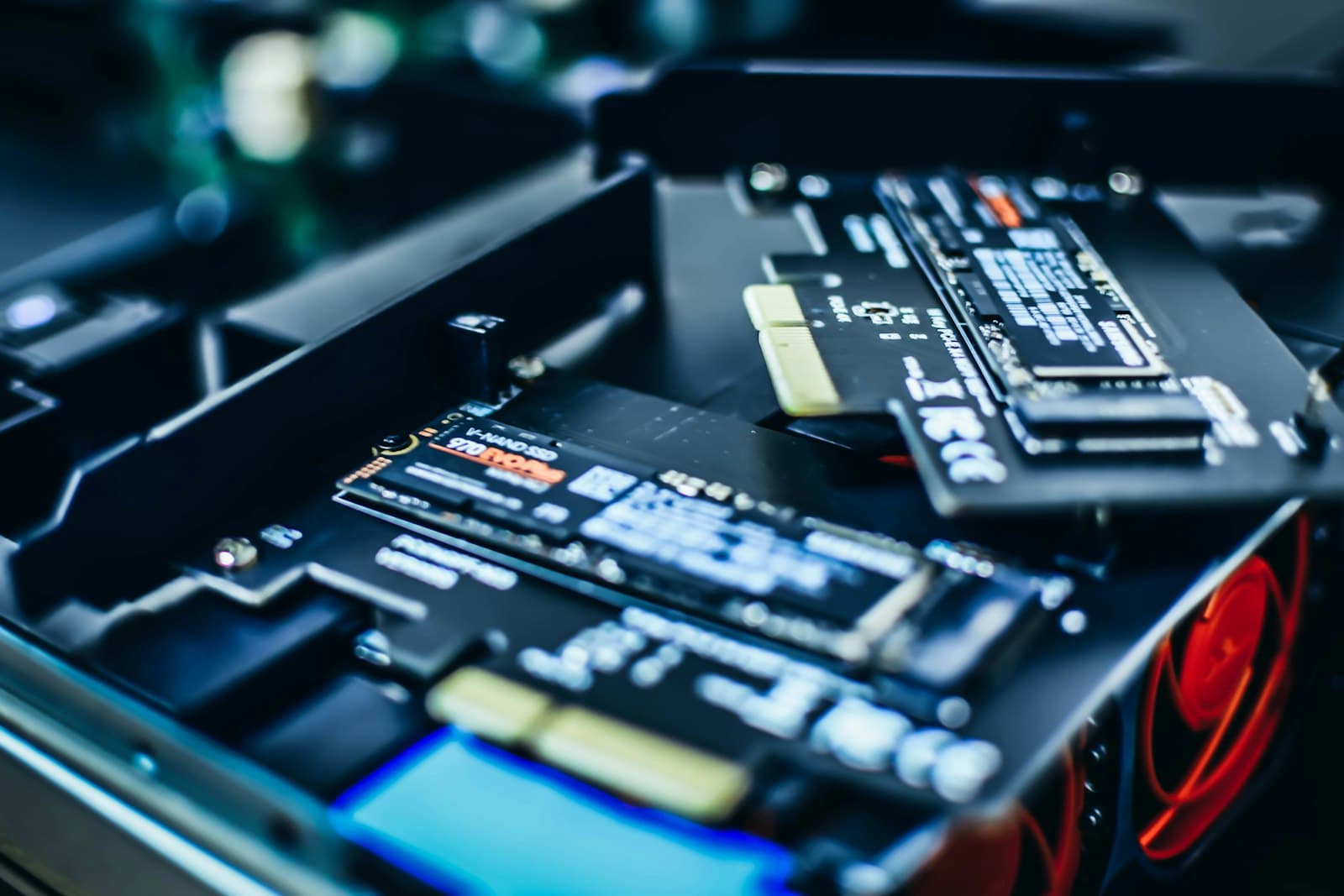
PCIe Gen5 (PCIe 5.0) doubles the per-lane bandwidth of Gen4, increasing from 2 GB/s per lane to 4 GB/s per lane in each direction. For NVMe drives operating at x4 lane width, this translates to a maximum interface bandwidth of 16 GB/s per drive, compared to 8 GB/s for Gen4. In practice, shipping PCIe Gen5 NVMe drives from Samsung, Micron, and Kioxia achieve 12 to 14 GB/s sequential read throughput, with write performance following close behind as NAND and controller technology matures. For AI storage, this shift is meaningful: a four-drive direct-attached NVMe configuration in a Gen5 server can now match the throughput of an eight-drive Gen4 system.
What Gen5 Changes for Dense Storage Configurations
The immediate practical benefit of PCIe Gen5 NVMe for AI infrastructure is drive count reduction for a given throughput target. A server targeting 40 GB/s of local storage throughput previously required five or six Gen4 drives; three or four Gen5 drives achieve the same target. This density improvement reduces drive bay consumption, PCIe slot usage, and in some cases power consumption. For storage servers with fixed drive bay counts, Gen5 effectively doubles the throughput that can be achieved in the same chassis. This matters significantly for GPU servers where PCIe lane budget is finite and shared between GPU, network, and storage connectivity.
Platform Requirements and Compatibility
PCIe Gen5 NVMe drives require a host platform with PCIe 5.0 slots. Intel's 4th and 5th generation Xeon Scalable processors (Sapphire Rapids, Emerald Rapids) and AMD EPYC Genoa and Bergamo processors provide PCIe 5.0 support. However, the PCIe 5.0 implementation must extend to the M.2 or U.2/U.3 drive slots, because not all Gen5-capable servers route Gen5 lanes to all storage slots. Verify the specific platform configuration, not just the processor generation. Thermal management also deserves attention: Gen5 drives under sustained load generate more heat than Gen4 equivalents and may throttle in enclosures with inadequate airflow.
- Confirm that PCIe 5.0 lanes are actually routed to your target drive slots in the specific server SKU you are evaluating.
- Evaluate drive thermals under sustained workloads: Gen5 drives can throttle in inadequately cooled environments.
- Gen5 NVMe enterprise drives carry a cost premium of 30 to 60 percent over equivalent Gen4 drives at current market pricing.
- Gen5 drives are backward compatible with PCIe 4.0 and 3.0 slots at reduced performance (useful for phased migration).
- Validate that your storage controller or software RAID stack supports Gen5 device queues and command set features.
- Benchmark with your specific I/O pattern before committing: some AI workloads are already latency-bound, not bandwidth-bound, and will not benefit from Gen5.
Gen5 and NVMe-oF Fabric Architectures
In disaggregated NVMe-oF storage architectures, PCIe Gen5 drives increase the throughput capacity of each storage node, allowing fewer nodes to serve larger GPU clusters. A Gen5 storage node with 24 drives can deliver roughly 300 GB/s of raw sequential read bandwidth, enough to serve dozens of concurrent GPU training jobs. The network fabric connecting storage nodes to compute nodes must be sized to match this target bandwidth; InfiniBand NDR (400 Gb/s per port) and Ethernet 400GbE are the interconnect technologies that can utilize Gen5 NVMe storage node capacity without becoming the bottleneck.
PCIe Gen5 NVMe is not just an incremental upgrade. It changes the feasibility boundary for direct-attached storage in GPU servers where every PCIe slot is contested.
How Nexus Compute Helps
Nexus Compute supplies PCIe Gen5 NVMe storage solutions integrated into validated GPU server and storage node configurations. We have benchmarked Gen5 drive performance across AI training I/O profiles and can advise on when the generation upgrade delivers meaningful throughput improvements for your workload versus when Gen4 remains the more cost-effective choice. Our AI storage portfolio spans both generations, and our solutions engineers will help you make the right call for your specific requirements.
Systems covered in this article
Planning a hardware investment?
Tell us what you're trying to build. A procurement specialist will help you specify and quote the right configuration within 48 business hours, no obligation.