All-Flash SAN vs NVMe Direct-Attached for GPU Clusters
Choosing between an all-flash SAN and NVMe direct-attached storage is one of the most consequential infrastructure decisions for GPU cluster design. This guide compares both architectures across bandwidth, latency, cost, and operational complexity to help AI teams make the right call.
When designing storage for a GPU cluster, two architectures dominate enterprise deployments: all-flash SAN systems accessed over Fibre Channel or iSCSI, and NVMe drives installed directly in each compute node. Both approaches can deliver the throughput AI training demands, but they differ substantially in how that throughput scales, how storage is managed, and what happens when workload requirements shift. Understanding these differences in depth is essential before committing to either architecture.
All-Flash SAN: Centralized Storage for Shared Access
An all-flash SAN presents storage as block devices to multiple hosts simultaneously, with a centralized storage controller managing drive media, caching, RAID, and replication. Modern all-flash arrays from vendors such as Pure Storage, NetApp, and Dell PowerStore achieve latencies below 500 microseconds and aggregate throughputs of hundreds of gigabytes per second. Their primary advantage for AI workloads is shared access: every compute node in a cluster can read from the same dataset volumes simultaneously without duplicating data, and storage capacity can be expanded independently of compute. SAN infrastructure also supports thin provisioning, snapshots, and replication natively: capabilities that matter for checkpoint management and dataset versioning.
NVMe Direct-Attached: Maximum Bandwidth Per Node
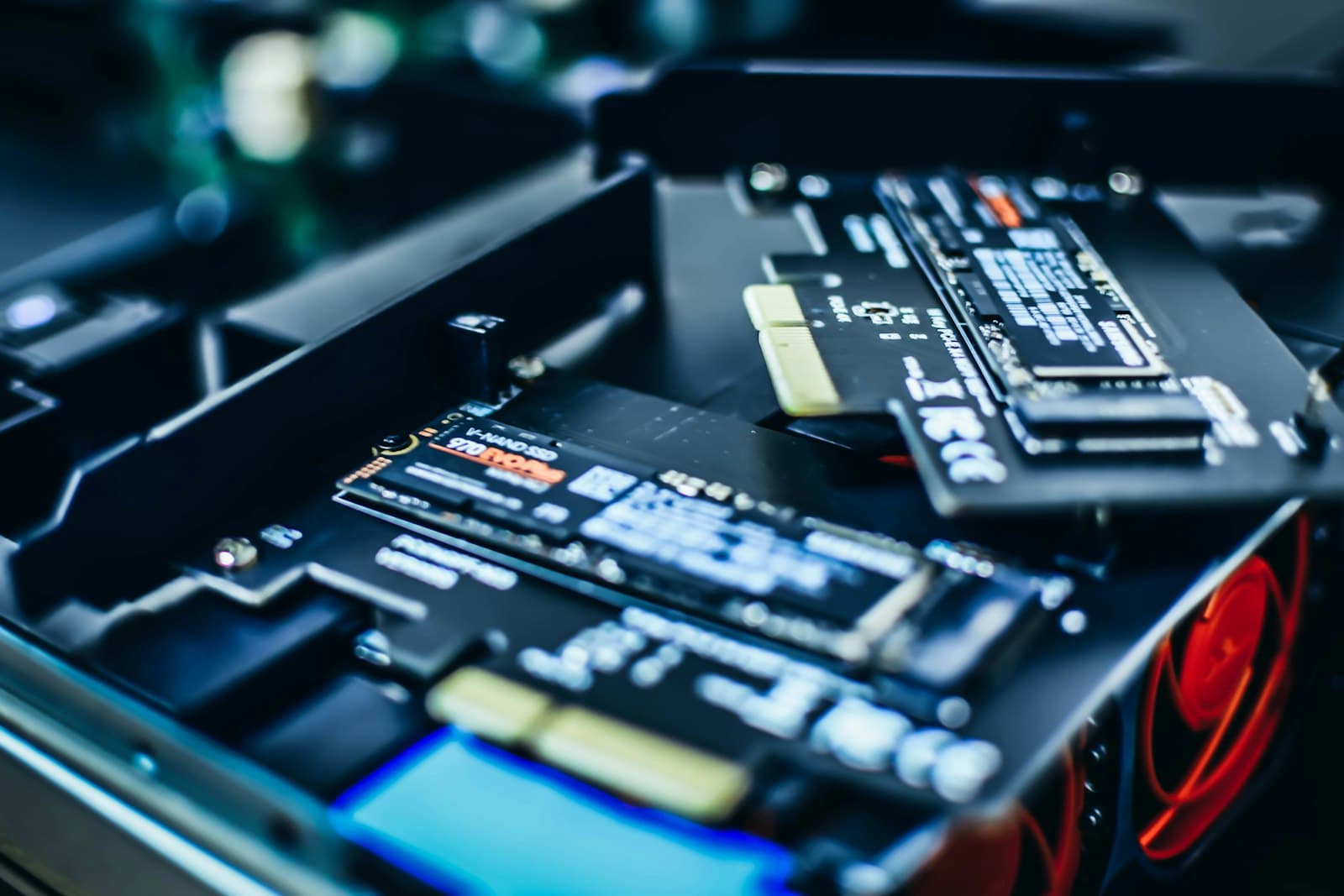
Direct-attached NVMe places drives inside each compute server, connected directly to the CPU via PCIe lanes with no intermediate network fabric or storage controller. A single server with eight PCIe Gen4 NVMe drives can achieve aggregate sequential read throughput of 50 GB/s or more, bandwidth that no shared storage fabric can match on a per-node basis. DAS eliminates network latency entirely and is immune to fabric congestion. The trade-off is that storage capacity is bound to compute nodes: scaling storage means scaling compute, and data sharing between nodes requires explicit data movement over the cluster network. For training jobs that run on a fixed node allocation with local datasets, DAS is often the higher-performance and lower-cost choice.
- SAN: optimal when multiple jobs need access to the same large dataset simultaneously without data duplication.
- NVMe DAS: optimal for maximum single-job throughput where the dataset fits within the local storage budget.
- SAN: preferred when storage capacity must grow independently of compute node count.
- NVMe DAS: preferred when cost-per-GB and cost-per-IOPS are the primary optimization targets.
- SAN: supports enterprise data management features (snapshots, replication, thin provisioning) natively.
- NVMe DAS: simpler operationally, with fewer infrastructure components and no SAN switches or HBAs to manage.
Latency and Throughput: The Real-World Gap
In controlled benchmarks, enterprise all-flash SANs approach local NVMe latency over FC or iSCSI. In production AI environments, SAN latency under heavy mixed-workload conditions (simultaneous training, checkpointing, and validation reads from multiple nodes) is measurably higher than local NVMe. For most AI training workloads, the practical latency difference is 2x to 5x. Whether that gap matters depends on your training framework's data loading pipeline: well-optimized pipelines with prefetching absorb SAN latency; poorly optimized pipelines stall on every I/O call.
Neither architecture is universally superior. SAN wins on flexibility and data sharing; NVMe DAS wins on raw per-node throughput. The right answer depends on your job mix and scaling model.
How Nexus Compute Helps
Nexus Compute has deployed both all-flash SAN environments and high-density NVMe direct-attached clusters for AI teams. Tell us your workload patterns, job concurrency, dataset sizes and budget, and we will quote against the architecture that fits, or a hybrid that combines shared SAN for datasets with local NVMe for checkpoint scratch space. We source, integrate, and validate the full storage stack, so your GPU cluster is ready to train from day one.
Systems covered in this article
Planning a hardware investment?
Tell us what you're trying to build. A procurement specialist will help you specify and quote the right configuration within 48 business hours, no obligation.