
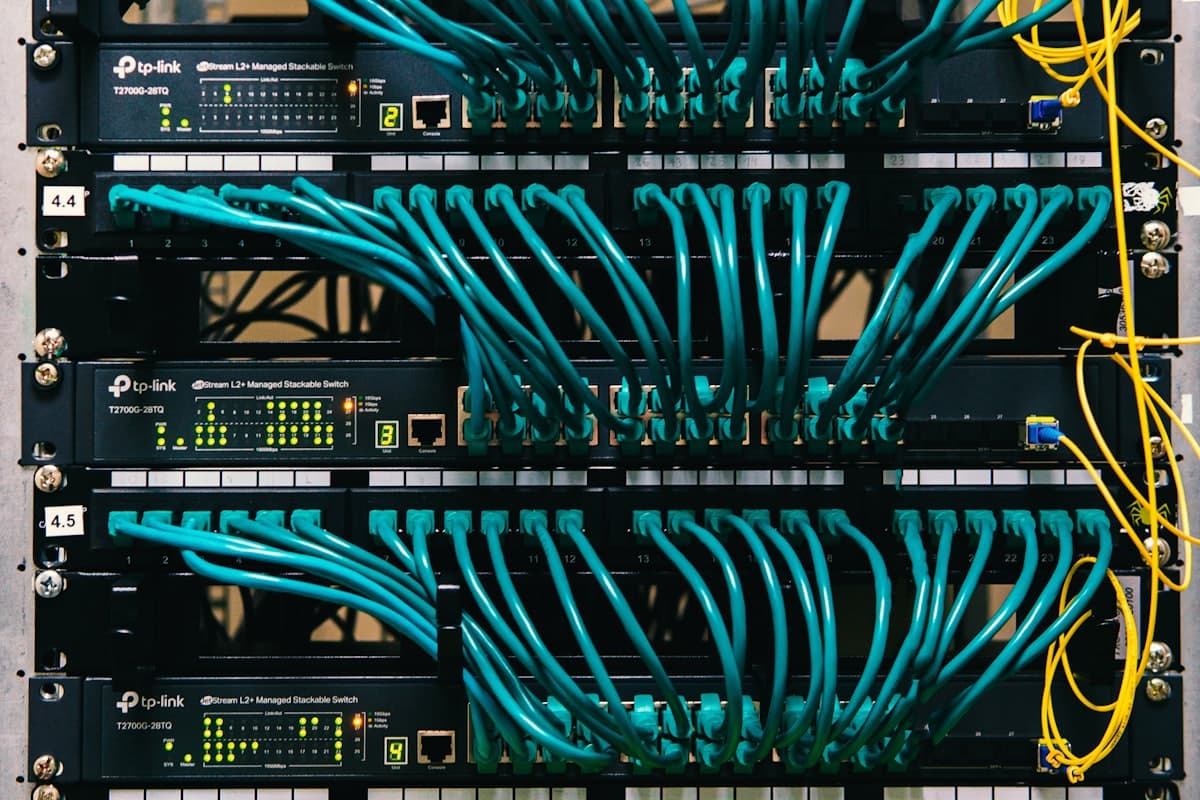
Cabling Infrastructure for High-Density GPU Racks: Fiber, DAC, and AOC
Cabling infrastructure for high-density GPU racks is frequently underplanned, with fiber, DAC, and AOC choices made at the last minute based on availability rather than performance requirements. This guide covers the selection criteria, insertion loss budgets, and installation practices that determine whether your AI cluster cabling survives its first year in production.
Physical cabling infrastructure is the least glamorous and most frequently neglected component of AI cluster design. It is also among the most consequential: a marginal optical link that intermittently drops packets causes RoCE queue pair errors and PFC storms that look like software bugs. Improperly labeled cables turn a 20-minute troubleshooting task into a 4-hour data center crawl. This guide covers the selection criteria, installation standards, and maintenance practices that keep high-density GPU rack cabling reliable under production conditions.
DAC, AOC, and Active Fiber: Choosing the Right Medium
Direct Attach Copper (DAC) cables are the lowest-cost, lowest-latency option for intra-rack connections up to 3 meters (passive DAC) or 7 meters (active DAC). At 400GbE and NDR InfiniBand, passive DAC is viable to approximately 2.5 meters before insertion loss exceeds receiver sensitivity margins. Active Optical Cables (AOC) use embedded transceivers to convert the electrical signal to fiber optic, enabling 10–100 meter runs with consistent signal quality. Discrete fiber optic transceivers (QSFP-DD SR4, FR4, LR4) with structured cabling provide the longest reach and the ability to reuse fiber plant across equipment refreshes, at higher per-port cost.
- DAC passive: ≤2.5m, lowest cost (~$50–150 per link), zero optical power budget concern
- DAC active: 3–7m, moderate cost (~$150–300), verify vendor compatibility with switch and NIC
- AOC: 10–100m, higher cost (~$300–800), field-replaceable if transceivers fail independently
- Structured fiber (LC/MPO): best for cross-rack and inter-row runs, enables cable plant reuse
- OS2 single-mode vs OM4/OM5 multimode: single-mode for >100m, OM4/OM5 for shorter runs at lower cost
- MPO-12 vs MPO-16 breakout: verify against QSFP-DD lane count (4x100G = MPO-12 or LC duplex)
High-Density Rack Cabling Practices
A single 42U GPU rack with two DGX H100 systems, two ToR switches, and associated infrastructure can contain 200+ cable terminations. Structured cabling practices are not optional at this density. Label every cable at both ends with source device, port, destination device, and port. Use color-coded jackets to distinguish RDMA training fabric cables from management and storage network cables. Install horizontal cable managers between devices to prevent cable droop onto GPU exhaust vents. Route fiber in enclosed raceways rather than bundled with power cables, because power cable magnetic fields cause measurable bit error rate increases in marginal fiber links.
Insertion Loss Budgeting and Testing
Every optical link in a 400GbE or NDR InfiniBand deployment should be tested against its insertion loss budget before the cluster enters production. QSFP-DD SR4 transceivers require total link loss below 1.9dB at 850nm, including fiber attenuation, connector insertion loss (0.3–0.5dB per mated pair), and any bend loss. An optical power meter and light source test at installation time takes 3–5 minutes per link and catches marginal connections that will fail intermittently under temperature cycling. Document test results per link. This baseline enables rapid diagnosis when link-layer errors appear in production monitoring.
The most expensive cabling decision is the one made under time pressure at cluster install. Specify fiber, DAC, and AOC types with part numbers during infrastructure planning, not on the day the GPU servers arrive.
How Nexus Compute Helps
Nexus Compute provides complete cabling bill-of-materials for each GPU cluster configuration we supply, specifying DAC, AOC, and fiber transceiver part numbers pre-validated for our server and switch combinations. We offer pre-racked and pre-cabled configurations where cable plant is installed, labeled, and tested before delivery to your data center. This eliminates on-site cabling risk and reduces deployment time from days to hours. Contact us for a cabling specification and pre-rack service quote.
Systems covered in this article
Planning a hardware investment?
Tell us what you're trying to build. A procurement specialist will help you specify and quote the right configuration within 48 business hours, no obligation.