NVIDIA Quantum-2 InfiniBand: Specifications and Enterprise Deployment Guide
NVIDIA Quantum-2 InfiniBand switches deliver 400Gb/s per port with in-network computing capabilities that accelerate AI collectives at scale. This enterprise deployment guide covers topology planning, rail optimization, and operational best practices for production AI clusters.
The NVIDIA Quantum-2 QM9700 switch represents the current apex of InfiniBand switching technology for AI infrastructure. With 64 ports of NDR 400Gb/s and NVIDIA's SHARP (Scalable Hierarchical Aggregation and Reduction Protocol) in-network computing engine, Quantum-2 can offload all-reduce operations from GPU compute cycles, a capability that fundamentally changes how enterprises should architect large training clusters.
Quantum-2 Core Specifications
- 64 ports of NDR 400Gb/s InfiniBand (51.2Tb/s total switching capacity)
- SHARP v3 in-network computing for all-reduce acceleration
- Sub-microsecond port-to-port latency (~130ns cut-through)
- Adaptive routing and credit-based flow control built into hardware
- UFM (Unified Fabric Manager) integration for centralized management
- Power: ~1,300W typical under full load; requires N+1 PSU planning
- Form factor: 2U, front-to-back airflow, compatible with standard enterprise racks
Fat-Tree Topology with Quantum-2
Enterprise deployments most commonly use a two-level fat-tree (spine-leaf) or three-level fat-tree topology depending on cluster size. For an 8-node cluster of DGX H100 systems (64 GPUs), a single Quantum-2 leaf switch provides full bisection bandwidth with no oversubscription. For 64-node clusters, a pair of Quantum-2 spine switches connected to eight leaf switches delivers a non-blocking fabric at 400Gb/s per GPU. The critical design choice is port split ratio: NDR 400Gb/s ports can be split to 2x NDR200 (200Gb/s) for higher port density where full 400Gb/s per GPU is not required.
Rail-Optimized vs. Fully-Connected Topologies
NVIDIA's DGX SuperPOD reference uses rail-optimized topology: each of the eight NVLink-connected GPUs in a DGX node connects to a dedicated spine rail, ensuring all inter-node GPU traffic traverses exactly one InfiniBand switch hop. This eliminates the latency variance introduced by adaptive routing across multiple hops and is the recommended approach for large-scale transformer training. Fully-connected all-to-all topologies offer simpler cabling but introduce routing non-determinism that can manifest as collective tail latency.
SHARP in-network computing can reduce all-reduce latency by up to 4x for large message sizes by eliminating the final reduction step from endpoint GPU memory. The reduction happens in the switch fabric itself.
Operational Considerations
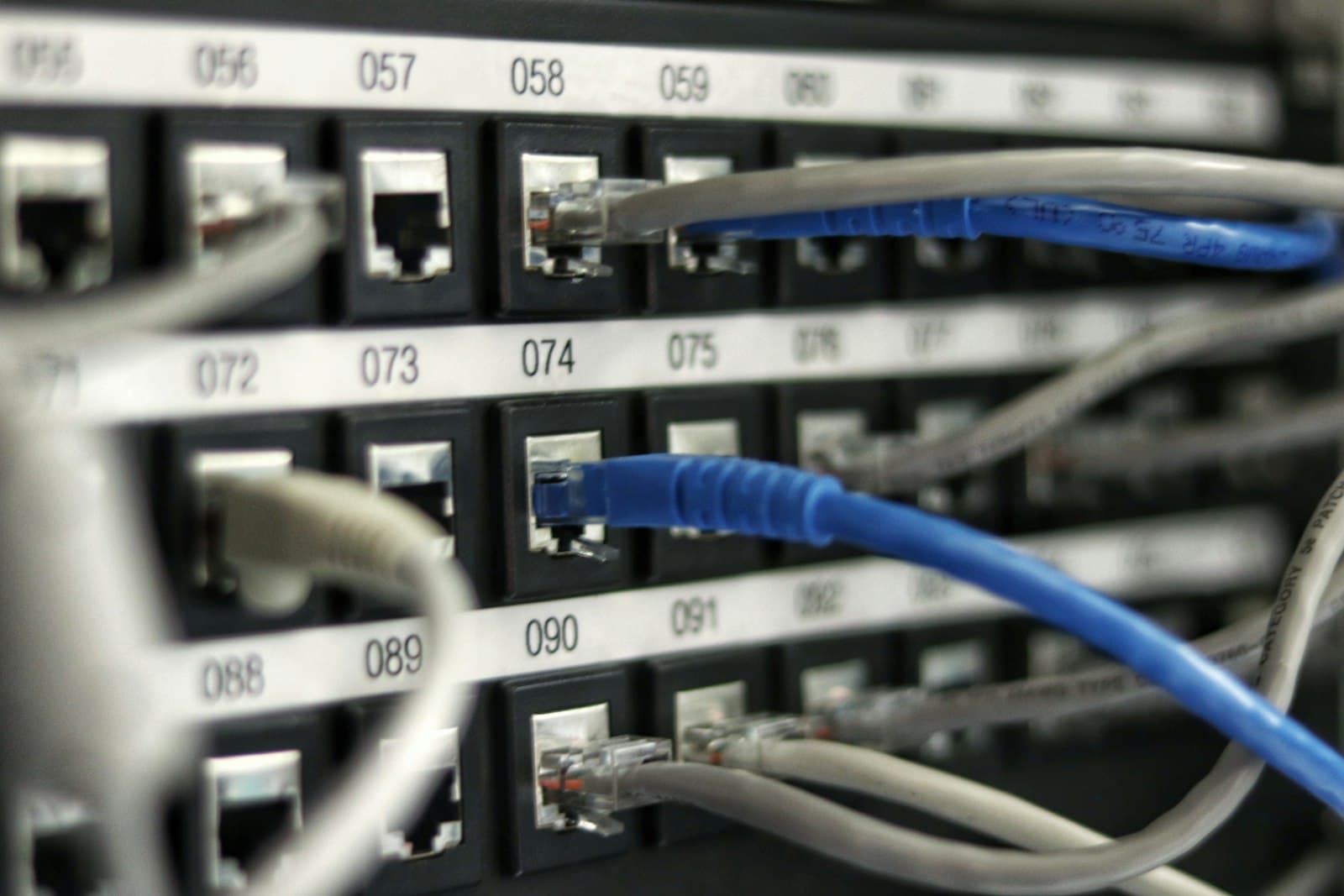
NVIDIA UFM is the management plane for production Quantum-2 deployments. It provides subnet management, routing algorithm selection (fat-tree, MINHOP, or DFSSSP), congestion control policy, and performance telemetry. Plan for UFM licensing costs as part of your total infrastructure budget. Cable plant for NDR requires QSFP112 active optical cables (AOC) or direct-attach copper (DAC) cables rated for NDR, since legacy HDR cables are not forward compatible. Document cable routing meticulously; rewiring a 512-GPU cluster is a multi-day maintenance window.
How Nexus Compute Helps
Nexus Compute sources NVIDIA Quantum-2 InfiniBand switches and ConnectX-7 HCA adapters through authorized distribution. We provide topology design services, pre-racked and pre-cabled configurations, and UFM deployment support. Our team has deployed Quantum-2 fabrics from 8-node test clusters to production environments exceeding 200 compute nodes. Reach out for a topology design consultation or to request a cluster configuration quote.
Systems covered in this article
Planning a hardware investment?
Tell us what you're trying to build. A procurement specialist will help you specify and quote the right configuration within 48 business hours, no obligation.